
Orca
An in-house webphone platform eliminating business telephony costs through direct provider integration and unlimited customization
Built in 2 months • Pre-revenue • Saving thousands monthly
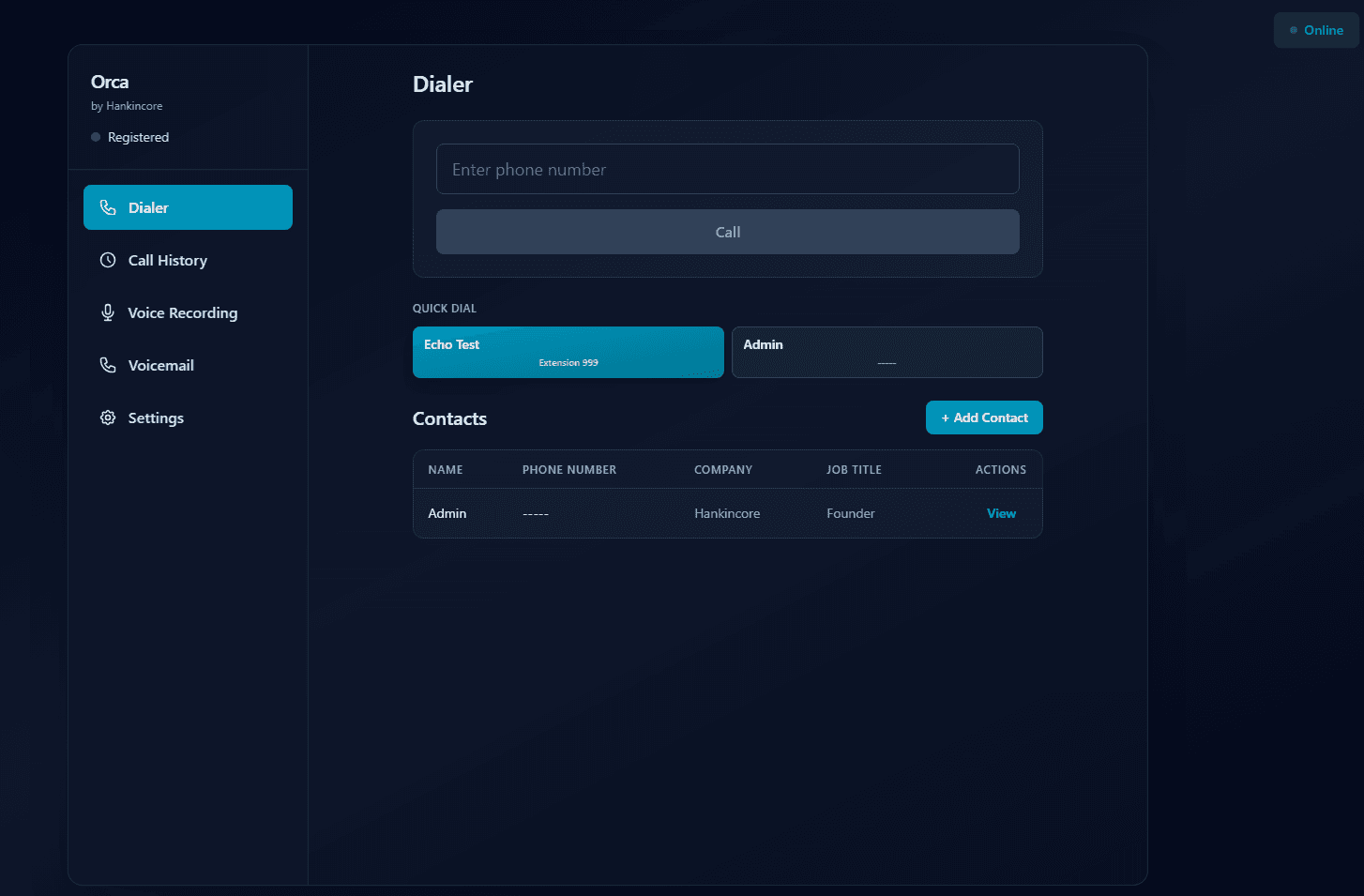
The Goal
Eliminate expensive business telephony costs ($500-$2000+ per seat per month) while gaining full control over our phone system with unlimited customization capabilities for database integration, AI assistants, and custom workflows.
Our Role
Full-stack development, VoIP provider integration, architecture design, and custom feature development. We negotiated directly with Australian telephony providers to acquire mobile and landline numbers at minimal cost, then built a scalable webphone platform from scratch.
The Outcome
A fully functional webphone platform costing less than $100/month total (vs $500-$2000+ per seat), with unlimited scalability, database integration capabilities, and the foundation for AI voice assistants. Complete control over every aspect of the system.
Why We Built Our Own Phone System
Business telephony solutions are notoriously expensive, with costs ranging from $500 to over $2,000 per seat per month. We needed a solution that addressed multiple critical requirements:
Prohibitive Costs
Traditional business telephony solutions charge $500-$2000+ per seat per month. For a growing team, these costs quickly become unsustainable, especially when you need multiple users per phone number.
Limited Customization
Existing solutions don't allow deep integration with our database to pull up customer information during calls, or implement custom AI voice assistants for handling routine tasks.
Scalability Constraints
Most platforms charge per user, making it expensive to have multiple team members share a single phone number simultaneously. We needed unlimited scalability without per-seat fees.
Vendor Lock-in
Relying on third-party platforms means being locked into their feature set, pricing model, and limitations. We needed complete control to build exactly what we need, when we need it.
Direct Provider Integration + Custom Platform
Instead of paying middlemen, we went directly to Australian telephony providers and built our own webphone platform with unlimited customization:
Direct Provider Integration
By negotiating directly with Australian telephony providers, we acquire mobile and landline numbers for less than $10/month each, with usage costs below $0.05 per minute. Server costs are under $50/month total for 5 users, resulting in 90%+ cost savings compared to traditional solutions.
Unlimited Customization
Complete control over every aspect of the system. We can integrate with our database to pull up customer information during calls, implement custom workflows, and build AI voice assistants for handling routine tasks—all without vendor limitations.
Endless Scalability
Multiple users can simultaneously use a single phone number without per-seat fees. The architecture is designed for unlimited scaling—add users, numbers, or features without exponential cost increases.
AI Voice Agents (Planned)
Built with AI integration in mind. We're developing AI voice-based assistants to handle simple tasks automatically, leaving our team free to focus on complex interactions that require human expertise.
From Concept to Production in 2 Months
Planning & Research
1-2 weeksResearching Australian telephony providers, evaluating VoIP solutions, and designing the architecture. Key decision: direct provider integration vs. using a middleman platform.
Core Development
6-8 weeksBuilding the webphone interface, VoIP server integration, and core calling functionality. Implementing extensions, voicemail, and call history features.
Integration Challenges
2 months totalThe most challenging phase: integrating multiple components (VoIP server, database, web interface, provider APIs) to work seamlessly together in a single server environment. This required careful architecture and debugging.
Feature Development
OngoingAdding database integration capabilities, contact management, voice recording, and ongoing feature enhancements based on internal usage.
Future: AI Voice Agents
PlannedDeveloping AI voice-based assistants to handle routine calls and tasks automatically, freeing the team to focus on complex interactions requiring human expertise.
Built for Control & Scalability
Every feature designed to give us complete control over our phone system with unlimited customization potential.
Phone Number Acquisition
Acquire Australian mobile and landline numbers directly from providers for less than $10/month each, with full control over number management.
Extensions System
Complete extensions system allowing multiple users to have their own extension numbers while sharing main phone numbers efficiently.
VoIP & Trunking
Full VoIP capabilities with trunking support, enabling high-quality calls over IP networks with efficient bandwidth usage.
Multi-User Per Number
Multiple users can simultaneously use a single phone number without conflicts or per-seat fees—unlimited scalability.
Voicemail
Complete voicemail system with message storage, retrieval, and notification capabilities integrated into the web interface.
Database Integration
Pull up customer data from our database during calls, enabling personalized service and instant access to account information.
Web-Based Interface
Fully functional webphone accessible from any browser, no desktop app required. Responsive design works on all devices.
Call History
Complete call logging with searchable history, call duration, and contact information for every interaction.
Voice Recording
Record calls for quality assurance, training, and compliance purposes with easy playback and management.
Settings & Configuration
Comprehensive settings panel for managing users, extensions, numbers, and system configuration with granular control.
AI Voice Agents (Planned)
AI-powered voice assistants to handle routine calls and tasks automatically, leaving complex interactions for human team members.
Endless Customization
Complete control over every aspect of the system. Build any feature, integrate any service, customize any workflow—no limits.
Built for Integration & Scale
⚛️ Frontend Stack
- Web-based interface (React/Next.js)
- Real-time WebSocket connections
- Responsive design for all devices
- Modern UI/UX with dark theme
🗄️ Backend & VoIP Stack
- VoIP server integration (SIP protocol)
- Direct provider API integration
- Database connectivity
- Single-server architecture
🔗 Integration Architecture
The biggest technical challenge was integrating multiple complex components—VoIP server, database, web interface, and provider APIs—to work seamlessly together in a single server environment. This required careful architecture design and extensive testing.
- VoIP server integration
- Real-time call state management
- Database query integration
- Provider API synchronization
- WebSocket event handling
- Concurrent call management
// Pull customer data during incoming call
async function handleIncomingCall(callId: string, callerNumber: string) {
  // Query database for caller information
  const customer = await db.customers.findFirst({
    where: { phoneNumber: callerNumber }
  });

  // Attach customer data to call context
  const callContext = {
    callId,
    callerNumber,
    customer: customer || null,
    customerHistory: customer
      ? await getCustomerCallHistory(customer.id)
      : [],
  };

  // Pass context to web interface for display
  await websocket.broadcast('call:incoming', callContext);

  // Enable AI assistant if customer is known
  if (customer) {
    await enableAIAssistant(callId, customer);
  }
}
Architecture Highlights
- ✓ Single-server architecture
- ✓ Real-time WebSocket communication
- ✓ Direct provider API integration
- ✓ Concurrent call handling
- ✓ Database integration during calls
- ✓ Scalable user management
- ✓ Multi-number support
- ✓ AI-ready architecture
Eliminating Middleman Costs
Direct Provider Relationships
By negotiating directly with Australian telephony providers, we eliminated middleman markups. Traditional solutions charge $500-$2000+ per seat, while our direct costs are:
Cost Comparison
For a team of 5 users, traditional solutions cost $2,500-$10,000+ per month. Our solution costs under $100/month total—a 90%+ cost reduction. Even with 50 users sharing numbers, costs remain under $200/month.
Commercial Potential
At our cost structure, we could offer this platform commercially at $50/month per user and still maintain healthy profit margins. The economics work because we've eliminated the middleman entirely.
Technical Challenges Overcome
Multi-Component Integration
Integrating VoIP server, database, web interface, and provider APIs to work seamlessly together in a single server environment was extremely challenging.
Designed a unified architecture with clear interfaces between components, implemented robust error handling, and used WebSockets for real-time communication between frontend and backend.
All components now work seamlessly together, with real-time call state updates, database queries during calls, and reliable provider API synchronization.
Provider Integration Complexity
Direct integration with Australian telephony providers required understanding complex APIs, SIP protocols, and telephony infrastructure.
Thorough research, API documentation analysis, and iterative testing. Built abstraction layers to handle provider-specific differences.
Reliable direct provider integration with minimal ongoing maintenance, achieving costs 90%+ lower than traditional solutions.
Concurrent Call Management
Multiple users need to simultaneously use the same phone number without conflicts or call routing issues.
Implemented intelligent call routing with extension-based distribution, call queuing, and state management to handle concurrent calls efficiently.
Multiple users can simultaneously use a single number without conflicts, enabling unlimited scalability without per-seat fees.
Real-Time Database Integration
Need to query database and display customer information during active calls without impacting call quality or introducing latency.
Asynchronous database queries with caching, WebSocket-based real-time updates, and optimized query patterns to minimize latency.
Customer data appears instantly during calls with zero impact on call quality, enabling personalized service and efficient call handling.
Massive Cost Savings & Complete Control
From expensive vendor lock-in to a cost-effective, fully customizable platform built in just 2 months.
Key Achievements
- ✓Reduced telephony costs by 90%+ compared to traditional solutions ($500-$2000+/month per seat → <$100/month total)
- ✓Complete control over phone system with unlimited customization capabilities
- ✓Database integration enables pulling customer data during calls for personalized service
- ✓Unlimited scalability—multiple users per number without per-seat fees
- ✓Foundation built for AI voice assistants to handle routine tasks automatically
- ✓Could be commercialized at $50/month per user with healthy profit margins
Key Learnings from This Project
Direct Provider Relationships Eliminate Costs
By going directly to telephony providers instead of using middleman platforms, we achieved 90%+ cost savings. The negotiation effort was worth it—eliminating vendor markups creates massive value.
Custom Solutions Provide Unlimited Flexibility
Building our own platform means we can integrate with our database, build AI assistants, and customize any workflow without vendor limitations. The initial development investment pays off in long-term flexibility.
Integration Complexity Requires Careful Architecture
Integrating multiple complex components (VoIP, database, web interface) in a single server was the biggest challenge. Careful architecture design upfront saved significant debugging time later.
Cost Savings Justify Internal Development
Even with 2 months of development time, the cost savings justify the investment. We're saving thousands per month compared to traditional solutions, and we have complete control over our phone system.
Ready to Build Your Custom Platform?
We build custom web applications, VoIP platforms, and internal tools that eliminate vendor lock-in and reduce costs. Let's discuss your project.